How to Choose the Right Ball Valve: A Practical Buying Guide
Contributors

Breaking News



Ball valves are everywhere in industrial plumbing, from fuel depots and chemical dosing skids to gas pipelines and municipal water mains. They are quick to operate, mechanically simple, and reliable across a wide range of service conditions. That reliability, however, depends on specifying the right valve for the job. A ball valve that looks fine on paper can fail prematurely, leak, or demand excessive operating torque if it is mismatched to its duty.
If you are tasked with selecting ball valves for a new project, or sourcing a like-for-like replacement during a maintenance turnaround, working through a handful of key criteria will help you land on the right specification the first time. Here is a practical framework to guide the decision.
1. Start with the service conditions
Before opening any valve catalogue, nail down the fundamentals of your application. What is the line media? Is it clean water, fuel, natural gas, slurry, steam, or an aggressive chemical? What are the expected operating temperature and pressure ranges, including surge and upset conditions? What is the pipe size, and how frequently will the valve be cycled? These answers drive almost every downstream decision, from body material to seat choice to actuation.
2. Floating or trunnion design
The two dominant ball valve designs behave very differently under pressure. A floating ball valve suspends the ball between two seats, with line pressure pushing the ball into the downstream seat to form a seal. It is simple, economical, and well suited to sizes up to around 6 to 8 inch and pressure classes of 150 to 300.
A trunnion ball valve fixes the ball on upper and lower pins. Spring-loaded seats seal against the ball from both sides, which keeps operating torque low and allows the design to scale comfortably into large bore and high pressure service. For applications above Class 300, for pipelines that require double block and bleed, or for high cycle automated duty, trunnion is generally the right call.
3. Body material
Match the body material to the media and the environment. Carbon steel (A105 forged or WCB cast) suits most general oil, gas, and industrial duty. Stainless steel grades such as 316 cover corrosive, marine, and hygienic applications. Duplex and super duplex stainless address chloride-rich environments such as offshore and seawater service. For extremely aggressive chemical duty, specialty alloys like Monel, Inconel, or Hastelloy may be required.
Do not forget the external environment. A valve installed in coastal, marine, or mining conditions may need a corrosion-resistant coating or a higher-grade material simply to survive atmospheric exposure, regardless of what flows through the pipe.
4. Seats and seals
Seats often fail before the body does, so choose them carefully. PTFE and reinforced PTFE (RPTFE) are the default soft seats for general service and deliver bubble-tight shutoff at moderate temperatures. PEEK and Devlon are useful where higher temperatures or mild abrasives come into play. Metal seats, sometimes with stellited or tungsten carbide facings, are specified for high temperature, abrasive, or fire-safe duty.
Stem seals follow the same logic. PTFE or graphite packing is common for general service, while flexible graphite is the standard for fire-safe qualification and high temperature applications.
5. End connections and body style
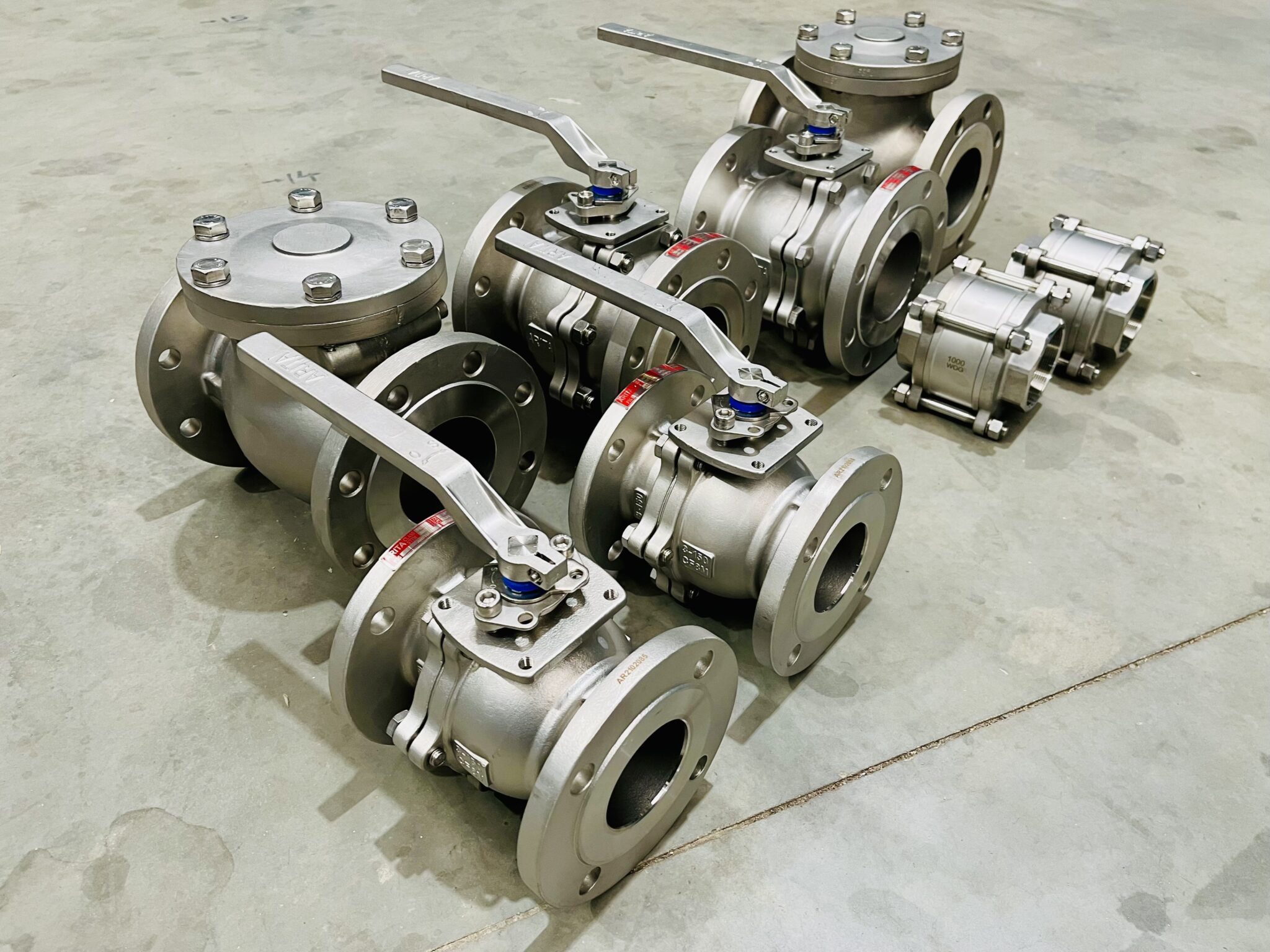
Threaded (BSP or NPT) ends suit small bore instrument, utility, and general service applications. Flanged ends to ASME B16.5 are the go-to for process piping above 2 inch and for anywhere a valve needs to be removed routinely for maintenance. Socket weld and butt weld ends suit high pressure and critical service where a leak path at a flange is unacceptable.
Body construction also matters. One-piece floating ball valves are compact but not serviceable. Two-piece and three-piece designs allow the valve to be disassembled for in-line maintenance, which is especially valuable in food, beverage, and pharmaceutical systems where regular cleaning is part of normal operation.
6. Pressure class and temperature rating
Pressure classes (150, 300, 600, 900, 1500, 2500) describe the valve's pressure and temperature envelope as defined by ASME B16.34. A Class 150 valve is not rated to 150 psi across its whole range. It follows a sliding scale that drops as temperature climbs. Always check the actual working pressure at your maximum operating temperature, not the headline number alone.
For cryogenic and high temperature applications, specify valves that are qualified to relevant standards such as BS 6364 for cryogenic service or API 607 and API 6FA for fire-safe performance.
7. Actuation and cycle frequency
For manually operated valves, lever handles suit small sizes, while gear operators become necessary as valve size and pressure climb. For automated duty, choose the actuator (pneumatic, electric, or hydraulic) to match the cycle speed, torque demand, and safety requirements of the system. Size the actuator for worst-case torque (dry conditions, end-of-life seats, and full pressure differential), not the nominal figure. High cycle applications favour trunnion designs with metal seats or upgraded soft seat materials to extend service life.
8. Standards and compliance
For oil, gas, hydrocarbon, and flammable media service, fire-safe qualification to API 607 or API 6FA is typically mandatory. Fugitive emission standards such as ISO 15848-1 and API 641 are increasingly specified for volatile services. For pipeline duty, conformance to API 6D covers design, testing, and marking. Check whether your project also requires hydrostatic or pneumatic testing beyond the manufacturer's factory scope, along with Material Test Reports and inspection certificates to EN 10204 3.1 or 3.2.
Sourcing the right valve
A well-specified valve still needs to come from a supplier who stands behind their stock. Australian industrial distributors carry a wide range of options, from entry-level utility valves through to pipeline-grade trunnion designs, and it pays to work with a supplier who can match the specification to the application rather than simply ship the cheapest part that fits the size. Specialist importers and distributors such as Fox Global stock a comprehensive range of ball valves across a variety of materials, pressure classes, and end connections, with the technical support to help specifiers and maintenance teams get the right valve into the pipeline the first time.
Taking the time to walk through these criteria before you order saves far more time and money than hoping the closest-matching valve on the shelf will do. Start with the service conditions, work methodically through materials and design, and finish on compliance. Get those basics right and a ball valve will run quietly for years, which is exactly what it is meant to do.